Before you continue reading, I feel it is important to include a gentle warning. This post shares my personal experience with a traumatic pregnancy and birth story. It is not graphic, but it may be upsetting for anyone who is sensitive to stories about pregnancy complications, premature labour, hospital bed rest, or difficult medical news. Please take care of yourself and read only if you feel able.
- Dominic’s Story: Part 1
- Dominic’s Story: Part 3
- Dominic’s Story: Part 4
Dominic’s Story: Part 2
Admitted
There was no time to think, prepare, or process what was happening. Everything moved so quickly. We were taken straight to the admitting department, where another long round of paperwork began. Before I fully understood what was happening, I had a hospital bracelet on my wrist, the clothes I had arrived in, and a stiff hospital bed waiting for me on the prenatal high-risk ward.
That night felt unreal. My husband kissed me gently and reassured me that he would be back in the morning before the next round of tests. Then he and my dad left to find a hotel room nearby. I watched them go, trying to be brave, but as soon as they were gone, the weight of it all settled over me.
And there I was, completely alone. I was in an unfamiliar city, in an unfamiliar hospital, in a room where I knew no one. There was no comfort, no certainty, and no promise that everything would be okay. I wiped my tears on the rough blue hospital gown, pulled out my little red flip phone, and called a woman from home named Sheila.
Sheila had recently welcomed me into a women’s Bible study that met over the lunch hour. I had not known her for very long, but in that short time she had shown me genuine kindness, warmth, and Christ-like love. I still do not know exactly why I called her in that moment. Maybe it was instinct. Maybe it was God. I simply scrolled to her name and pressed send.
She answered, and I cried. I poured out every fear, every broken thought, and every bit of confusion I had been holding in. She listened with patience and compassion. Then she prayed. She prayed for protection, for hope, for healing, and for peace. By the time we ended the call, I was exhausted in every possible way. I had cried out all the words I had, and eventually I drifted into a restless, uneasy sleep.
Premature Labour
Shortly after midnight, I woke up in pain. At first, I tried to convince myself that it was nothing. I told myself I was scared, overtired, and probably overthinking every sensation in my body. But after about half an hour, the pain had not gone away. It was getting stronger.
I reached for the nurse-call button beside my hospital bed and pressed it. When the nurse answered through the intercom, I told her I was in pain and that something felt wrong. A nurse came into my room soon after. She asked a few quick questions, examined me, and then called the doctor who was on duty that night.
Before I could fully understand what was happening, I was connected to machines and monitors. My bed was being rolled out of the room and down the hall toward labour and delivery. I remember thinking, over and over again, that this could not be right. I was only 25 weeks pregnant. It was far too soon.
The bright lights and white hallways seemed to rush past me. There were needles, medications, specialists, and the constant beeping and buzzing of hospital machines all around. Everything felt urgent. The room filled with movement and voices, and underneath it all was the terrifying knowledge that something was very wrong.
Someone must have called my husband, because suddenly he was there. He rushed into the room and came straight to my side. Around us, we heard pieces of medical conversation that we could barely process. “Too soon.” “She’s dilating.” “The baby’s not ready.” “Try this.” “Try that.” We were trying to piece together what it all meant while fear rose around us like a wave.
Eventually, after a stretch of time I still cannot clearly measure, a doctor sat beside me and explained what was happening. I was in active preterm labour, and the medical team was doing everything they could to stop it.
So we prayed. We cried. We pleaded. Then we prayed again. I knew with every part of me that our tiny little boy was not ready for this big world yet. All we could do was hold on to each other, trust the people caring for us, and beg God for more time.
Permanent Bedrest
By the grace of God, the help of modern medicine, and perhaps a little bit of luck, my labour began to slow as morning arrived. The contractions grew farther apart, and I stopped progressing at the alarming rate that had frightened everyone during the night.
But even though the immediate crisis had calmed, everything had changed. The doctors told me I would not be going home for the rest of my pregnancy. I would remain in the hospital on strict bed rest until my baby arrived. The hope was that he would stay safely inside for as long as possible.
In an instant, life stopped. There would be no more work, no return to my own warm bed, no quiet comfort of home. My family and friends were far away. My husband had to go back north because bills still needed to be paid and life outside the hospital continued, even though mine felt frozen. My dad stayed for a few extra days while I tried to settle into my new hospital room and accept what had become my new normal, but he had to leave too.
My days became a routine of tests, specialists, monitoring, television, reading, and waiting. Every few days, the hospital arranged a group activity for those of us on strict bed rest. Some of us were wheeled in our beds, while others came in chairs, and we gathered in the community area of the ward. The staff would lead a craft or a simple activity, and for a little while we could talk with other women who understood, in some way, what it felt like to wait and worry.
During that time, I learned how to knit. I also made a glass mosaic frame. Those small activities did not take away the fear, but they gave my hands something to do and my mind something else to focus on, even briefly.
Deep Loneliness
The days passed slowly, filled with deep loneliness and constant fear. Time felt heavy. I missed my home, my husband, my family, and the ordinary life I had taken for granted. The silence in the room could feel overwhelming, especially at night.
One bright spot during those long days was a very special nurse. Whenever she was on shift, she came in with such gentleness and kindness. She would sit with me while completing my daily monitoring and simply talk. Her presence brought comfort in a place where comfort was hard to find. She treated me not just like a patient, but like a person who was scared and needed someone to stay for a moment.
About two and a half weeks later, on a Friday, I had an MRI. Later that day, there was a knock on my hospital room door. Three specialists came in: an OBGYN, a perinatologist, and an ENT specialist. They stood at the foot of my bed with the gentle, careful expressions I had started to recognize.
They explained that, after reviewing everything, they believed they had reached a consensus about what was happening with my son. They told me they believed he had a rare genetic disorder called Treacher Collins.
And once again, my world came crashing down.
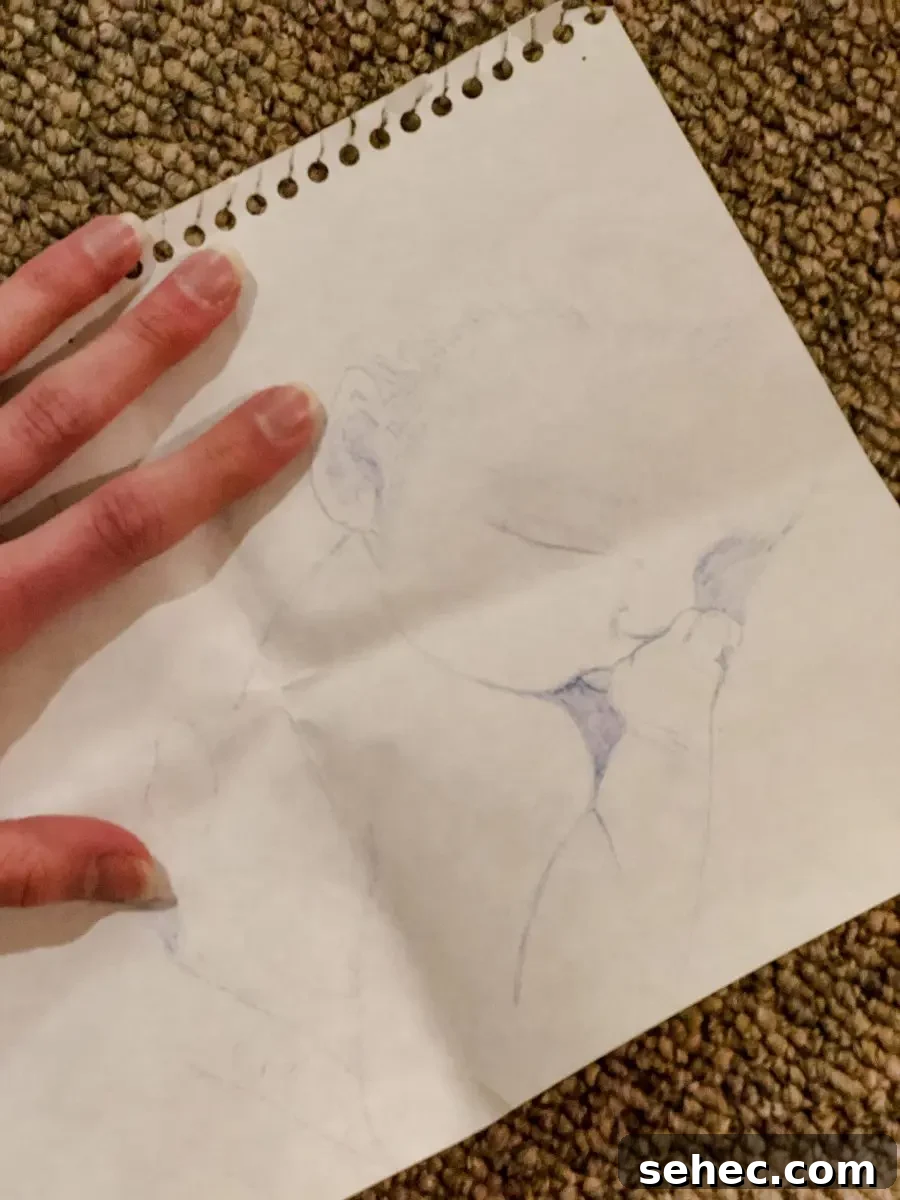
A picture I sketched of my son while I was on hospital bed rest.