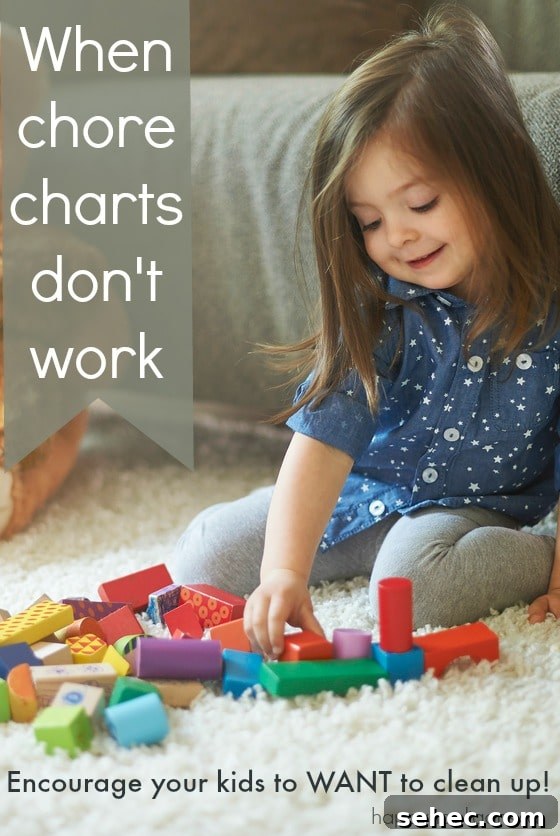
You may start a new chore chart with the best intentions and plenty of hope, but what happens when the whole system falls apart? If chore charts are not working for your family, do not panic. There are other practical, positive ways to encourage children to help around the house and take responsibility for their own messes.
Here is how to get your kids to clean up after themselves and share household responsibilities without relying on a chore chart.
Messy bedrooms, towels on the floor, toys scattered across the living room, craft supplies on the table, shoes in the hallway… it can feel endless. When you have children, mess is part of daily life. After a full day of playing, building, creating, exploring, snacking, and experimenting, your home can look as if a small storm passed through it.
At one point, I was convinced I had found the perfect solution. I believed I could create a simple system that would motivate the kids to clean up after themselves without arguments, reminders, frustration, or constant nagging.
I made adorable little chore charts. Every time the children completed a task, they earned a ticket. Those tickets could then be traded for special privileges. It sounded simple, cheerful, and completely reasonable. Of course the kids would want the privileges, and of course my house would become cleaner with less effort from me. It seemed like a perfect win-win.
Except it was not.
Not even close.
That dream of a tidy home and a no-nagging chore chart system collapsed in less than a week. I put the charts away for a while, adjusted the plan, and tried again a few weeks later. I hoped the second attempt would be more successful.
But it was not.
Within a few days, I was back to reminding, pleading, and repeating myself. The cute chart on the wall was not enough to build lasting habits or make household chores magically appealing.
Apparently, teaching kids to clean up after themselves is not as simple as making a pretty chore chart and expecting everything to fall into place.
Can you relate?
If getting your children to help around the house feels like a daily battle, and if chore charts have never worked well in your home, you are not alone. Many families struggle with kids’ chores, routines, and household responsibilities. The good news is that there are other effective ways to teach children to clean up, contribute to the family, and become more responsible.
What to Do When Chore Charts Don’t Work:
Set Realistic Expectations When Asking Kids to Clean Up
It is natural to want a clean, peaceful, organized home. However, when children live in the house, it is important to adjust your expectations. A perfectly tidy, magazine-style home is not always realistic, especially during busy seasons of family life.
If you expect children to clean like professional housekeepers, they may feel overwhelmed, and you may feel disappointed. Instead, focus on progress, participation, and consistency. The goal is not perfection. The goal is to teach your children how to notice mess, take care of their belongings, and contribute to the home in a meaningful way.
Accept that:
- There will still be fingerprints on windows, walls, or furniture from time to time.
- There may still be a few toys, books, or puzzle pieces left on the floor.
- Your home may not look as spotless as the pictures you see online or in magazines.
- Most importantly, your kids will be learning how to help, and that matters more than perfection.
Prepare to Repeat Yourself
You can have the most organized chore system in the world, and your children will still need reminders. Kids are still learning routines, responsibility, time management, and follow-through. A chart may tell them what to do, but it does not automatically create a habit.
You will probably need to repeat yourself often, especially in the beginning. That does not mean you are failing. It means your children are still learning. Try to keep your tone calm and clear so the reminders do not turn into nagging.
Simple checklists can work better than complicated reward systems. Give each child a short “to-do” list and place it somewhere visible, such as on the refrigerator, a bedroom wall, or a family command center. Children can check off tasks as they complete them, which gives them a clear sense of progress and responsibility.
Make Cleaning Up a Game
Instead of connecting every chore to a reward, try making clean-up time feel more playful. Children often respond well to games, challenges, music, and movement. Set a timer and challenge everyone to finish before it rings. Play a favorite song and aim to tidy the room before the music ends.
A little friendly competition can be a powerful motivator. You might say, “Can we get all the blocks into the bin before the timer goes off?” or “Let’s see if we can clear the table before this song is over.” Cheer each other on and keep the mood light.
For younger children, a clean-up song can be especially helpful. Sing while everyone works together, and keep singing until the toys are back where they belong. This makes the routine predictable and fun, and it turns clean-up into a shared activity rather than a punishment.
Remove Distractions
One of the simplest changes you can make is to remove distractions before asking children to clean. This can make a surprisingly big difference.
Think about how hard it is for adults to stay focused when phones, messages, television, or emails are competing for attention. Children struggle with this even more. If the television is on or a tablet is nearby, cleaning up will feel almost impossible to them.
Before starting chores, turn off the television, put away tablets, pause video games, and remove anything that pulls attention away from the task. Once the distractions are gone, children are often faster, calmer, and more focused. This simple step can reduce frustration for everyone.
Keep the Chores Age-Appropriate
It may seem obvious that you should not ask a toddler to unload the dishwasher or carry a heavy trash bag, but age-appropriate chores matter for older children too. A task should match the child’s ability, strength, attention span, and level of independence.
For example, an older child may understand how to take out the trash, but if the trash can is too heavy or difficult to move, the task may not be appropriate without help. A younger child may not be ready to clean an entire room alone, but they may be able to put stuffed animals in a basket or place books on a shelf.
Choose chores that your child can reasonably complete. When children experience success, they are more likely to cooperate and feel proud of their contribution. As they grow, you can gradually add more responsibility.
We’re All in This Together
Children need to understand that the home belongs to the whole family, and everyone who lives there has a role in taking care of it. Household chores should not feel like random punishments or jobs assigned only when someone is in trouble.
Explain that families work as a team. Everyone eats in the kitchen, uses the bathroom, walks through the hallway, and enjoys the shared living spaces. That means everyone can help keep those spaces clean and comfortable.
This approach also helps reduce complaints such as, “But I didn’t make that mess,” or “Why do I have to help?” The answer is simple: because families help each other, and everyone benefits when the home is cared for.
Be Specific
When you say, “Clean your room,” you may know exactly what you mean. Your child may not. That instruction can feel too big, too vague, and too overwhelming. A child who does not know where to begin may simply shut down, complain, or avoid the task entirely.
Instead, give clear and specific directions. Say, “Put the blocks in the block bin,” “Place the dirty clothes in the hamper,” or “Put the books back on the shelf.” Small, direct instructions are easier for children to understand and complete.
Breaking a large job into smaller steps helps children build confidence. Over time, they will begin to understand what “clean your room” includes, but in the beginning, they need guidance and structure.
It’s Not Easy, But It Is Worth It.
Teaching children to help with household chores takes patience. It is not always quick, and it is rarely perfect. There will be days when you feel like you are repeating the same instructions over and over. There will be days when it feels easier to do everything yourself.
Still, the effort is worth it. When children learn to clean up after themselves, they develop responsibility, independence, teamwork, and respect for shared spaces. The earlier you begin, the more natural these habits become. Over time, helping around the house becomes part of the family routine, and children are less likely to resist bigger responsibilities as they grow.
You may decide that chore charts are not the right fit for your family, and that is perfectly fine. A successful household routine does not have to depend on stickers, tickets, or rewards. With realistic expectations, clear instructions, age-appropriate chores, and consistent encouragement, kids can learn to help at home in a way that actually works.
Take the De-Clutter Challenge!
Is your cluttered home feeling so overwhelming that you do not know where to begin?
Start with one small area and give yourself a simple challenge: choose a drawer, shelf, basket, or corner and clear it completely. Small wins can build momentum. As clutter decreases, it becomes easier for the whole family to keep the home organized and easier for children to know where things belong.
More Solutions to Common Parenting Challenges:
Practical ways to reduce sibling fighting and encourage children to get along
Simple ideas to help teens remember to hang up their towels
What to consider when a child wants to quit an extracurricular activity
Helpful strategies for children who are afraid to sleep alone